Image: Kinek00 / Shutterstock.com
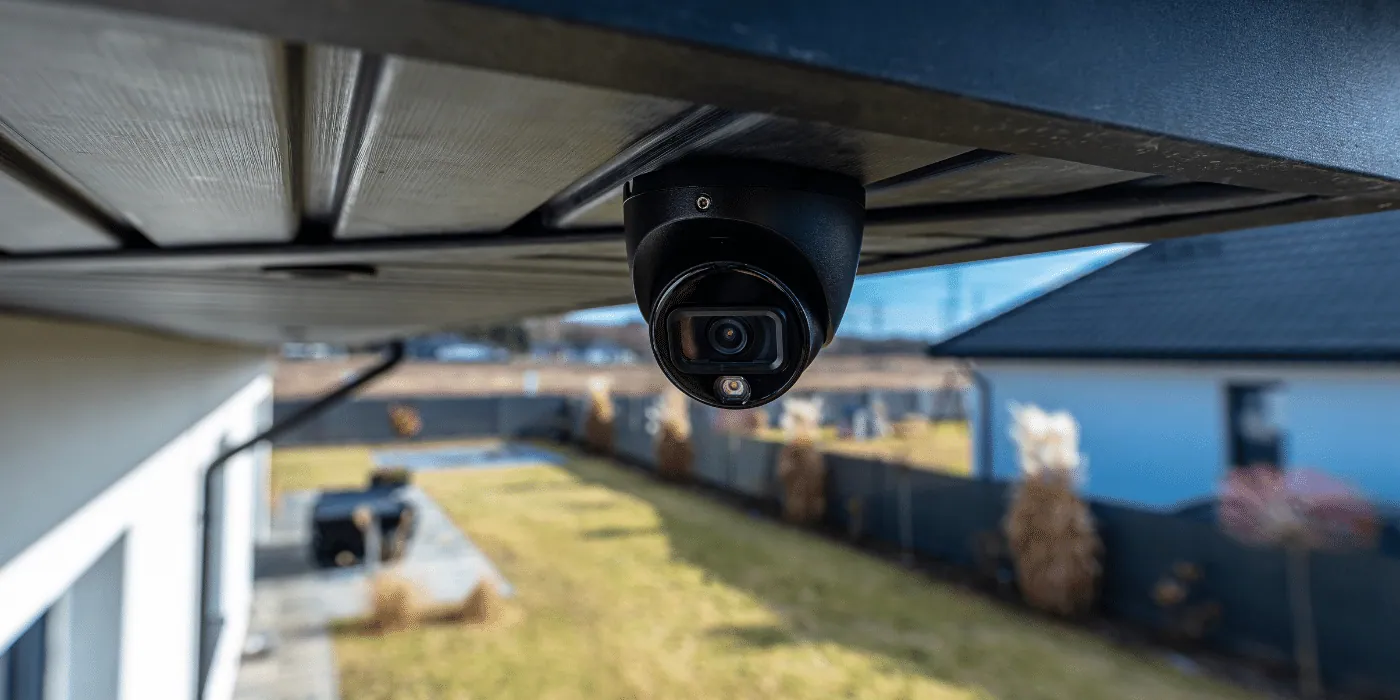
A camera on a neighbor's house can be reassuring—after all, everyone wants to protect their property. But what happens if the lens is pointed not only at your own front door, but also at the neighbor's yard, driveway, or sidewalk?
Then it’s no longer a case of “It’s just a camera.” After all, neighbors aren’t automatically required to allow others to observe who enters or leaves their property and when.
At the same time, however, it is also true that not every camera pointed toward a neighbor is automatically prohibited. What matters is what the camera is actually recording and whether the alleged surveillance can be specifically proven.
Your own yard: Cameras allowed—the neighbor's yard: Keep your hands off
Anyone who wants to protect their own home and property from burglars or vandalism is generally allowed to use a security camera. That is, at first glance, completely legitimate.
The boundary is reached when areas suddenly come into view that no longer have anything to do with one’s own property. This becomes particularly tricky when it comes to neighboring properties, shared areas, and public sidewalks or streets.
The reason is simple: People should be able to move about freely on their own property without constantly feeling like they're being watched by their neighbors.
Even a camera that captures only a small portion of a neighbor’s property can therefore become a problem. Data protection authorities expressly point out that monitoring a neighbor’s property is generally not permitted.
The key point: What does the camera actually see?
This is precisely where the crux of many neighborhood disputes lies.
From the outside, a camera may appear to be pointing directly at a neighbor's property. However, that does not automatically mean that people are actually being recorded there.
Modern cameras are capable of technically blurring out certain areas of the image. This is done using what are known as “privacy zones.” A portion of the image is then permanently blacked out or otherwise rendered unrecognizable. Although the camera can continue to point in that direction, the relevant image data is not recorded in a usable format in the first place.
The Ansbach Administrative Court addressed precisely this question in 2026.
In that case, a property owner was concerned that a camera on the neighboring property might also capture his property. However, the operator had set up a technical masking feature. As a result, the affected area of the property was permanently blocked from view.
The neighbor argued that the setting could, in theory, be changed again at some point.
That did not convince the court. What mattered was what actually happened at the time of the examination—not what might theoretically happen at some point.
Suspicion alone isn't always enough
This is important—but possibly sobering—news for those affected.
Anyone who files a complaint with the data protection authority about a camera should provide as much specific information as possible. A vague sense of unease alone is not necessarily sufficient.
In the Ansbach case, screenshots, among other things, showed that the area of land in question had in fact been permanently excluded from the recording.
This shows that when it comes to a dispute over a camera, it's not just a matter of where the device is mounted. It also depends on its technical settings.
Anyone who wants to challenge the use of a camera should therefore document as objectively as possible what can actually be seen. Photos of the camera, its orientation, and—to the extent possible—information about the area it covers can be very helpful later on.
And what about the feeling of being constantly watched?
This is where things get particularly interesting. That’s because data protection and neighboring rights are not exactly the same thing. The data protection authority is primarily concerned with determining whether personal data is actually being processed.
To put it simply: Are people actually being recorded, and are those recordings being processed?
However, there is a second level to consider. Even the mere possibility that a neighbor could be observed at any time can be legally problematic. For this to be the case, however, the fear must be understandable.
For example, in 2024, the Gelnhausen Municipal Court ruled on a case involving an electronically adjustable camera. The device could technically be aimed at the neighboring property. In the court’s view, the neighbor was not required to tolerate such a situation because it could give rise to a reasonable fear of being monitored at any time.
This shows that sometimes it really doesn't matter whether someone is actually being filmed. The mere possibility of surveillance can be enough to make a difference.
But even a neighbor can't just demand anything
People often forget the other side of the coin. Anyone who feels they are being watched by a camera cannot automatically demand that it be removed.
In 2025, the Berlin Court of Appeals also heard a case involving such a dispute. In that case, the neighbor’s mere concern was not sufficient. There was a lack of concrete evidence that surveillance was actually taking place or that there was a serious risk of it occurring.
The cameras were fixed in position and, according to the court’s findings, primarily covered the operators’ own premises. In addition, the operators were able to document how the cameras were set up.
The message is therefore quite clear: A neighborhood dispute alone does not make a camera illegal surveillance.
Anyone who claims to be under surveillance should therefore provide as specific details as possible.
What should those affected do now?
Anyone who finds a neighbor's camera to be a problem shouldn't immediately resort to the most extreme measures.
A good first step might be to have a calm conversation. This often helps clarify exactly what area the camera is covering and whether any technical shielding has been installed.
If that doesn't help, those affected should document the situation. Photos of the camera and its orientation can be just as important as screenshots or other verifiable evidence of the actual field of view.
You can then determine whether it is advisable to file a complaint with the relevant data protection authority.
If, on the other hand, the main issue is that even the mere possibility of surveillance creates significant pressure, taking the matter to a civil court may also be an option.
That's why it's important to start with a very simple question:
What exactly is the problem—the actual recording, or the well-founded fear of being recorded at any time?
That may determine which path is the right one.
And what should the camera owner know?
There is also a simple basic rule for the person who installed the camera: Capture as little of other people's property as possible.
Anyone who wants to monitor their own property should therefore aim the camera as precisely as possible. If technically feasible, areas belonging to others should be permanently excluded from the camera's view.
You should be especially careful with cameras that can automatically rotate or pan. This is because a camera that can be pointed at a neighbor’s property at any time can be significantly more problematic from a legal standpoint than a fixed camera with a clearly defined field of view.
And there's one more thing to keep in mind: Just because a camera is supposedly used for security doesn't automatically mean it's unproblematic.
"I just want to deter burglars" is not a free pass to monitor your neighbor's yard at the same time.
Technology can disrupt peace in the neighborhood
The real scandal is often not the camera itself, but the lack of communication leading up to it.
Anyone who installs a camera should be able to explain to their neighbor, without making a big fuss, what the camera sees—and what it definitely does not see. If that requires a five-minute explanation, you should take those five minutes.
Conversely, however, not every camera should be deemed a case of personal surveillance. If someone suspects—merely because of a neighborhood dispute that has already escalated—that another person might be filming them, that does not constitute proof.
A camera may be used to protect one's own property. However, it must not become a digital pair of binoculars peering over the garden fence.
And anyone who can prove to their neighbor that their property has been properly excluded from the plans will likely not only have the stronger legal position—but also a significantly better chance of preventing two neighbors from becoming adversaries in court.
Protect your privacy from unauthorized surveillance. Get legal advice now and find out your rights!
to the lawyerAt a fixed price of 169 EURO (gross)