

As seen in










Black Week
at Recht 24/7
15% off the fee for all fixed-price services, plus free Black Week specials.
Ends Monday, 30 Nov at 11:59 pm
The discount is applied automatically at checkout.
View all fixed-price services3 months of trademark monitoring
We watch for new filings of similar trademarks. Ends automatically, no subscription.
30 days of Legal Department 24/7
Our AI for contracts and legal questions around your business, 1,500 credits. Ends automatically.
First month of legal texts
Imprint, privacy policy, T&Cs and withdrawal policy up to date right away. Then 15% off, cancel monthly.
Annual package: 12 months in advance
Pay once, covered for a year. Then €29.90 a month, cancel monthly.
Services
Our consultation services.
Employment lawyer
€169Instead of €169 now €143.66Employment lawyer online: written advice within 24 hours on a termination, termination agreement or formal warning.
Tenancy lawyer
€169Instead of €169 now €143.66Tenancy lawyer online: written advice within 24 hours for tenants and landlords.
Legal advice
€169Instead of €169 now €143.66Online legal advice directly from the law firm: a salaried lawyer replies in writing within 24 h, follow-up questions included.
Termination for owner occupancy
€169Instead of €169 now €143.66Received a termination for owner occupancy? A lawyer checks in 24 hours for a €169 fixed price whether it is valid.
Unfair dismissal claim
€169Instead of €169 now €143.66Filing an unfair dismissal claim? A lawyer reviews your termination for €169 in 24 hours, incl. severance check.
By area of law
What do you need help with? Choose your topic.
Employment law
Tenancy law
Inheritance law
Contracts
Guidance
Which service is right for you?
You have received a dismissal from your employer.
Important: An unfair dismissal claim must be filed within 3 weeks of receipt. Our recommendation: employment law consultation, or the unfair dismissal claim directly if you want to sue.
You are in a dispute with your landlord or tenant.
Utility bill, defects, deposit or owner occupancy: Our recommendation: tenancy law consultation, or for owner occupancy the specialized consultation on termination for owner occupancy.
You do not know which area of law your case involves.
Contract trouble, a dispute with neighbors, a claim against you: Our recommendation: initial consultation on your case. A lawyer assesses your matter and tells you the next step.
How it works
Here's how it works.
Choose a service and book. You choose the right consultation and pay the fixed price online. The price is fixed in advance.
Describe your case. After booking, you describe your matter in our form and upload documents. It takes a few minutes.
Your lawyer gets back to you. A lawyer at our law firm reviews your case and gets back to you within 24 hours with a clear assessment and recommendation.
Why Recht 24/7
A law firm. Not a referral service.
Permanently employed lawyers
Your case stays in-house. We never pass anything on to outside law firms.
Fixed price upfront
You know what it costs before you hire us. No hourly rates, no extra charges.
Response in 24 hours
A lawyer gets in touch with you within 24 hours, not someday.
Insured up to €2.5 million
As a German law firm, we are liable for our advice. Professional liability insurance through HDI, for every case.
Clear results and recommendations
You get clear advice, no empty phrases. "Legal made simple" applies to our language, too.
Across Germany, before any court
Sound advice from our lawyers. We represent our clients nationwide, all the way to court.
Fixed price guaranteed
Lawyer assigned
Response within 24h
FAQ
Frequently asked questions.
Not listed? Write to us using the contact form.
A lawyer permanently employed by Recht 24/7. We do not pass your case on to third parties.
The fixed price is set before you book: €169 including VAT. No hourly rates are added for the described scope of service.
A lawyer gets back to you within 24 hours of receiving your case description.
No. The consultation takes place entirely online and in writing. You do not need an in-person appointment.
Yes. You instruct a licensed law firm. We are liable for the advice with an insured sum of up to €2.5 million.
Your lawyer tells you exactly which further steps make sense and what they cost. You decide whether to commission them.
Yes. After booking, you upload contracts, letters or official notices directly in the form.
That depends on your policy. Ask your insurer before booking. We issue you an invoice with all the required details.
Guides. Employment law
All 38 guides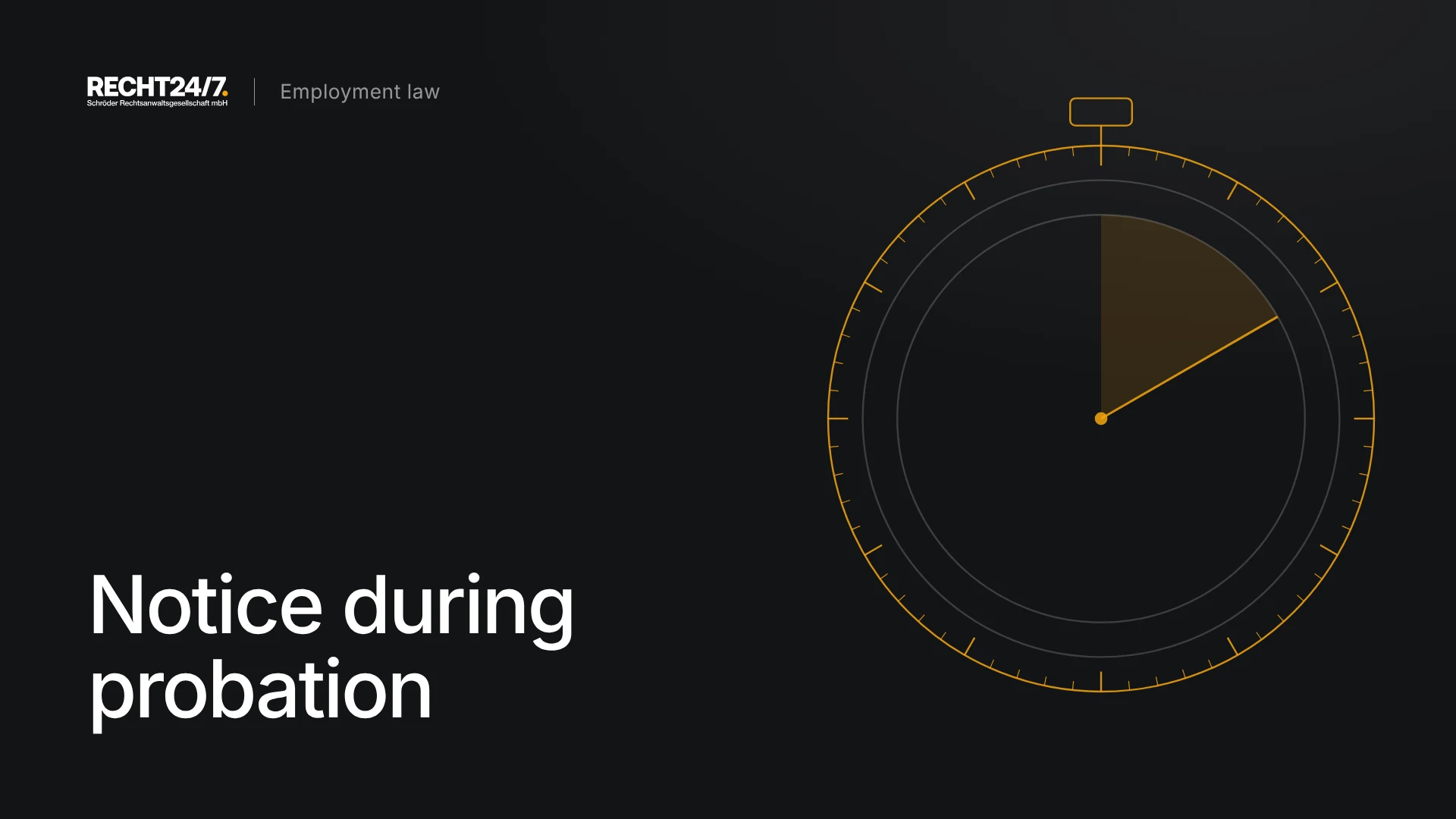
Notice period during probation: how to count the 2 weeks
The notice period during probation is 2 weeks, for you and for your employer, provided a probationary period of no more than 6 months has been agreed (Sec. 622 (3) BGB). The 14 days start on the day after the written notice is received and end on the same weekday two weeks later, without a fixed date such as the 15th or the end of the month. If the notice is received on the last day of probation, the short period still applies.
8 min read
Summary dismissal: when it is valid and what you need to do now
A summary dismissal ends the employment immediately, without a notice period. It is only valid if there is good cause that makes it unreasonable to wait for the normal notice period, and if it is given within 2 weeks of learning of the reason (Sec. 626 BGB). If you want to fight it, your claim must reach the labour court within 3 weeks of receipt (Sec. 4 and 13 (1) KSchG).
8 min read
Severance pay by years of service: what you can expect after 5, 10, 15, 20 or 30 years
The rule of thumb in Germany is half a gross monthly salary per year of service. Severance after 10 years is therefore around 5 monthly salaries, after 20 years around 10. The factor 0.5 is also mentioned in Sec. 1a KSchG, but there is only a statutory right to severance in exceptional cases: the actual amount is a matter of negotiation and depends above all on how vulnerable your dismissal is.
8 min readTenancy law
All 18 guides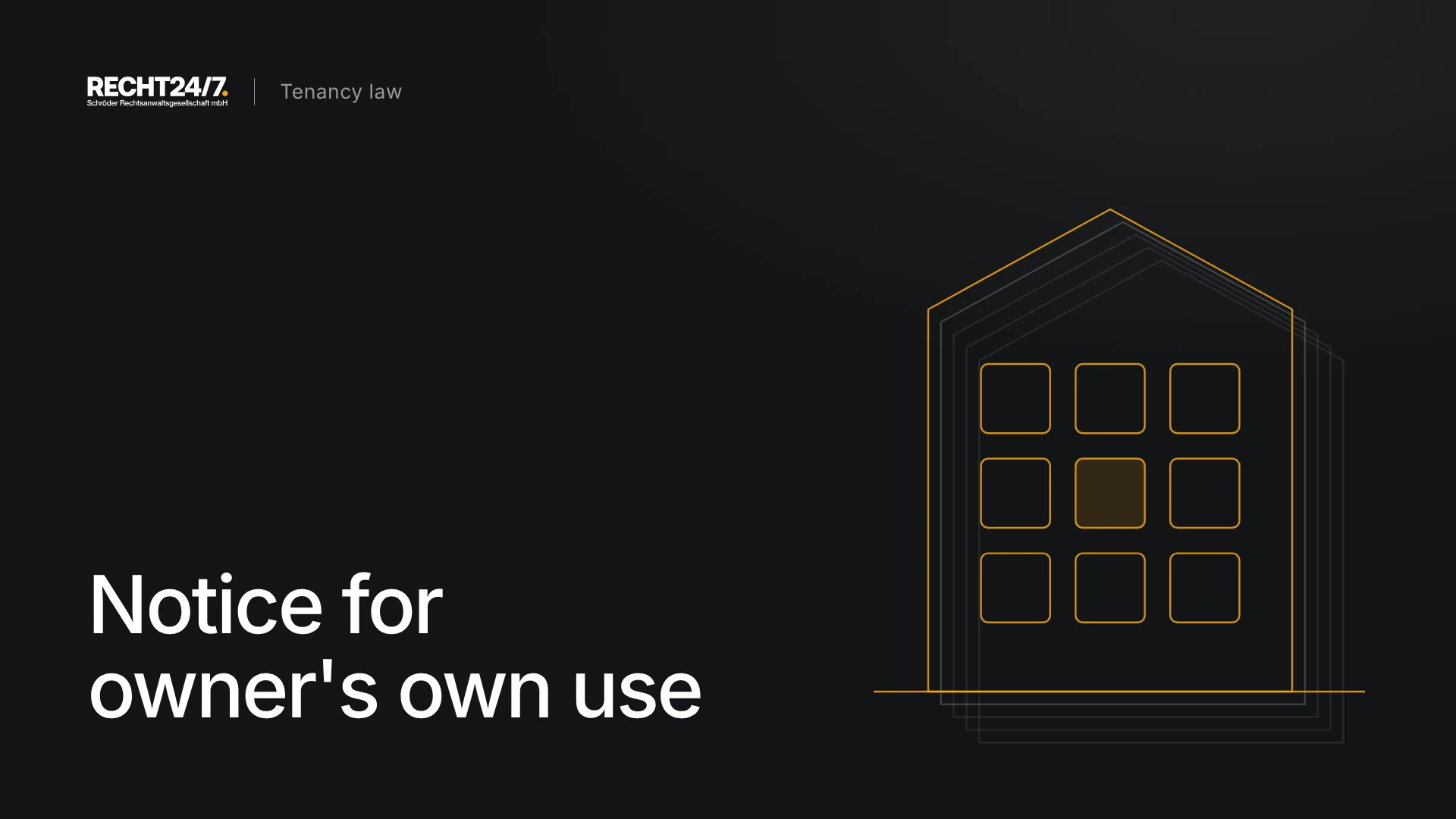
Notice for own use: what tenants and landlords need to know
With a notice for own use (Eigenbedarfskündigung), the landlord terminates the tenancy because they need the flat for themselves, their family members or members of their household (Sec. 573 (2) no. 2 BGB). Depending on how long you have lived there, the notice period is 3, 6 or 9 months, and the notice must be received by the 3rd working day of a month at the latest (Sec. 573c (1) BGB). If moving out would mean particular hardship, the tenant can object in text form no later than 2 months before the end of the tenancy (Sec. 574, 574b BGB).
15 min read
Rent increases: what your landlord may and may not do
Your landlord may request a rent increase up to the local comparative rent (ortsübliche Vergleichsmiete) one year after the last increase at the earliest, and it takes effect 15 months after that at the earliest. Within 3 years, the rent may rise by no more than 20%, in areas covered by a state ordinance by no more than 15%, and never above the comparative rent (Sec. 558 BGB). You have until the end of the second calendar month after receipt to give your consent, and the new rent applies from the third month (Sec. 558b BGB).
11 min read
Notice period for a rented flat: when your tenancy ends
As a tenant, your notice period for a flat is 3 months, no matter how long you have lived there. The notice must reach the landlord by the 3rd working day of a month at the latest, and the tenancy then ends at the end of the month after next. If the landlord gives notice, their period is extended to 6 and 9 months after 5 and 8 years since the handover (Sec. 573c (1) BGB).
7 min readInheritance law
All 18 guides
Writing a will: how to set out your last wishes correctly
You can write a will without a notary if you write it entirely by hand and sign it yourself (Sec. 2247 BGB). You should state the place and date, and the signature should contain your first name and surname. A will typed on a computer that you merely sign is invalid.
12 min read
The Berlin will: when it fits and when it becomes a trap
With a Berlin will (Berliner Testament), spouses appoint each other as sole heirs in a joint will, and the children only inherit after both have died (Sec. 2269 BGB). This provides for the surviving partner, but after the first death it usually binds them permanently to the joint rules (Sec. 2271 (2) BGB). The children can already claim their compulsory share on the first death, and with larger estates their tax-free allowance after the first parent goes unused.
12 min read
Compulsory share of an inheritance: entitlement, amount and calculation
Children, spouses and registered civil partners can claim the compulsory share (Pflichtteil) if they have been disinherited by a will or a contract of inheritance; if the deceased had no children, the parents can also claim it. Grandchildren can only claim it if their parent cannot, for example because that parent died first. It amounts to half of the statutory share of the inheritance and is a monetary claim against the heirs (Sec. 2303 BGB). If the wife inherits alone under the statutory matrimonial property regime and there are two children, that is one eighth of the estate per child, so €25,000 for an estate of €200,000. The claim becomes time-barred three years after the end of the year in which you learned of the death and your disinheritance.
15 min readFamily law
All 6 guides
Cost of a divorce: what to expect from the court and the lawyer
The cost of a divorce in Germany depends mainly on the spouses' income. The court sets a value of proceedings, usually three times the joint net monthly income plus a share for the pension rights adjustment (Sec. 43 and Sec. 50 FamGKG). The court fees and the statutory lawyer fees are calculated from this value. With a joint net income of 5,000 euros a month and an amicable divorce with one lawyer, the total comes to around 3,400 euros: about 810 euros for the court and around 2,600 euros for the lawyer. You share the court costs, each spouse pays their own lawyer (Sec. 150 FamFG).
5 min read
Year of separation: what applies until the divorce?
As a rule, a marriage in Germany can only be dissolved once the spouses have lived apart for at least one year (Sec. 1565 (2) BGB). After one year of separation, the marriage is deemed to have broken down if both want the divorce or one consents (Sec. 1566 (1) BGB). If one spouse does not want a divorce, three years of separation are generally enough (Sec. 1566 (2) BGB). The year of separation begins as soon as one spouse recognisably no longer wants to live with the other and the shared household ends. You can even stay in the same home (Sec. 1567 (1) BGB). There is no application or registration.
4 min read
Maintenance during separation: how much are you entitled to after separating?
If spouses live apart, the spouse with the lower income can claim maintenance from the other that reflects the previous standard of living (Sec. 1361 BGB). According to the Düsseldorf Table (as of 1 January 2026), the need is generally 45% of the difference between the adjusted earned incomes. The paying spouse must keep a retention amount of 1,600 euros if they work, otherwise 1,475 euros. The claim exists from separation until the divorce becomes final. For the past, maintenance is only payable from a written request (Sec. 1613 BGB).
4 min read