In short
You can write a will without a notary if you write it entirely by hand and sign it yourself (Sec. 2247 BGB). You should state the place and date, and the signature should contain your first name and surname. A will typed on a computer that you merely sign is invalid.
Key points
- There are two ordinary forms: the handwritten will and the will made before a notary (Sec. 2231 BGB).
- Handwritten means: the whole text in your own handwriting, with your signature at the end. You may make a will from the age of 16, but a handwritten one only from 18 (Sec. 2229 (1), Sec. 2247 (4) BGB).
- Only spouses and registered civil partners can make a joint will.
- A later will revokes an earlier one to the extent that it contradicts it (Sec. 2258 BGB).
- Official safekeeping at the local court costs a one-off €82, plus registration in the Central Register of Wills.
Contents
- Do you need a will?
- Which form of will suits you?
- Writing a will in 7 steps
- Formal requirements for a handwritten will
- Wording modules for your will
- These mistakes make a will invalid or contentious
- What may go into a will and what may not?
- Joint will for married couples
- Keeping your will safe: at home, at the local court or with a notary
- Changing or revoking a will
- What does a will cost?
- When a self-written will is not enough
- FAQ
Do you need a will?
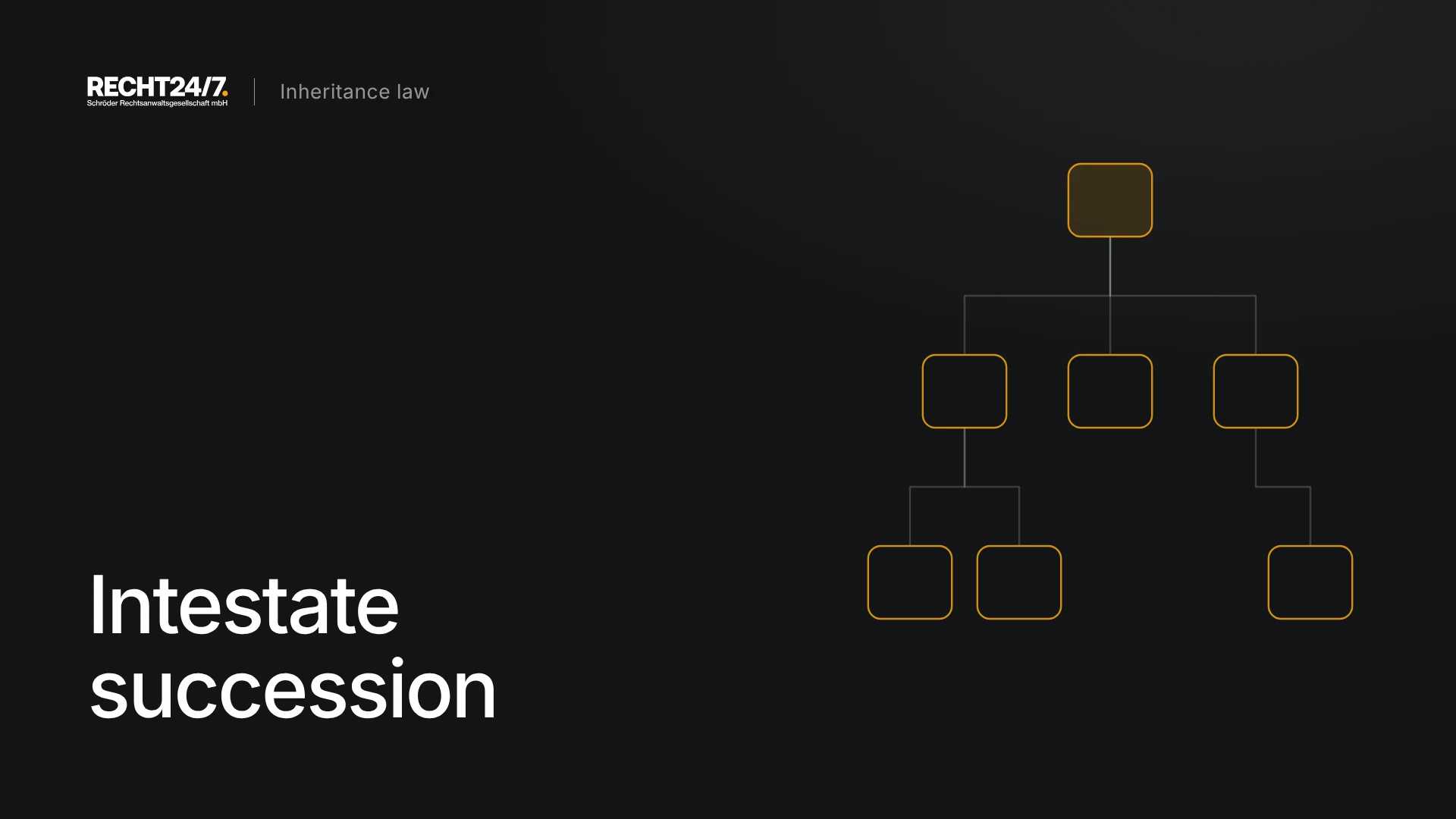
Without a will, intestate succession applies. It distributes the estate by family relationship in orders: first your children and grandchildren inherit (Sec. 1924 BGB); if there are none, your parents and their descendants, which includes your siblings (Sec. 1925 BGB). A closer relative excludes the more distant order. Alongside them, your spouse inherits a quarter if there are children, and half alongside parents or siblings (Sec. 1931 (1) BGB). If you live in the statutory matrimonial property regime of the community of accrued gains (Zugewinngemeinschaft), your spouse's share increases by a further quarter (Sec. 1371 (1) BGB). The same applies to registered civil partners (Sec. 6, 10 LPartG).
You need a will above all if the law does not fit your life:
- Unmarried partner: inherits nothing without a will.
- Stepchildren and blended families: stepchildren are not statutory heirs.
- Married couple without children: your parents or siblings inherit alongside your spouse.
- Specific items: the flat is to go to your daughter, the car to your nephew.
- Minor children: you want to decide who becomes their guardian (Sec. 1782 BGB).
- Charitable cause: an association or foundation is to receive something.
Which form of will suits you?
The law recognises two ordinary forms: recorded by a notary or by a handwritten declaration under Sec. 2247 BGB (Sec. 2231 BGB). In addition, there are the joint will of spouses and the contract of inheritance (Erbvertrag).
| Form | How | Costs | Security | Replaces the certificate of inheritance? | Suitable for |
|---|---|---|---|---|---|
| Handwritten will | written entirely by hand and signed (Sec. 2247 BGB) | free of charge; official safekeeping €82 plus registration | errors of form and interpretation possible, risk of loss if kept privately | usually not, heirs often need a certificate of inheritance | simple circumstances, clear succession |
| Notarial will | declaration to the notary or handing over a document (Sec. 2232 BGB) | 1.0 fee under Table B, e.g. €273 for assets of €100,000, plus VAT, expenses, safekeeping €82 and registration | advice and instruction by the notary, safekeeping at the court | often yes, for the land register together with the record of opening (Sec. 35 (1) GBO) | real estate, businesses, blended families |
| Joint will | spouses or civil partners; handwritten: one writes, both sign (Sec. 2267 BGB), or before a notary | handwritten free of charge; notarial 2.0 fee, e.g. €546 for €100,000 | binding effect of mutually dependent dispositions | handwritten usually not, notarial often yes | married couples who want to provide for each other |
| Contract of inheritance | only before a notary with both parties present at the same time (Sec. 2276 BGB) | 2.0 fee | contractual binding effect | often yes | unmarried couples, business succession |
Notary costs under the GNotKG (Court and Notary Fees Act), as at 9 November 2026; calculation at the end of the file.
Who may make a will? Anyone aged 16 can make a will, without their parents' consent (Sec. 2229 (1) and (2) BGB). Minors can only do so before a notary, however, by oral declaration or by handing over an open document (Sec. 2233 (1) BGB). Anyone who cannot understand the meaning of their declaration because of a mental disorder cannot make a will (Sec. 2229 (4) BGB).
Writing a will in 7 steps
- List your assets: accounts, real estate, securities, vehicles, jewellery, shareholdings, but also debts. Note what belongs to you and what you own jointly with others.
- Decide on your heirs: who is to receive your assets as a whole or as a fraction? Heirs take over all rights and obligations, including debts.
- Name substitute heirs: what happens if an heir dies before you or disclaims the inheritance? You can appoint others for this case (Sec. 2096 BGB).
- Set out legacies: individual items or sums of money for people who are not to become heirs (Sec. 1939 BGB).
- Testamentary directions, executor, guardian: you can oblige heirs to do something (Sec. 1940 BGB), appoint an executor (Sec. 2197 BGB) and name a guardian for minor children (Sec. 1782 BGB).
- Write by hand: the whole text, without a pre-printed form and without a typewriter or computer.
- Place, date, signature: at the end of the text, with your first name and surname.
Formal requirements for a handwritten will
Written in your own hand: The entire text must be written by you personally by hand (Sec. 2247 (1) BGB). If this form is missing, the will is void (Sec. 125 BGB). A text written on a computer that you merely sign is not enough, nor is a text that someone else has written for you.
Pen and paper: The law does not prescribe a particular pen. A ballpoint or fountain pen is the safe choice. Wills written in pencil are not automatically invalid, but they are easier to alter and more likely to lead to disputes. Any kind of paper will do, but a proper sheet is better than a scrap of notepaper.
Signature: It should contain your first name and surname (Sec. 2247 (3) sentence 1 BGB). A different form of signature, such as "Your father", is only harmless if it can be established with certainty that the will comes from you and is meant seriously (Sec. 2247 (3) sentence 2 BGB). The signature belongs below the text, because it is meant to conclude it.
Place and date: You should state on which day and at which place you wrote the will (Sec. 2247 (2) BGB). If this information is missing, the will is not automatically invalid. However, if doubts arise as a result, for example because there are two wills and it is unclear which is the later one, it is only valid if the time and place can be established in another way (Sec. 2247 (5) BGB).
Several pages: Number the pages, write a note such as "Page 1 of 2" on each page and sign at the end of the entire text.
Changes and additions: Deletions and additions should also be handwritten, dated and signed. For anything more than minor corrections, it is better to rewrite the will completely.
Legibility: Write clearly. A will that nobody can read does not help your heirs.
Wording modules for your will
We deliberately do not show a finished template to copy. A will must fit your assets and your family, and an unsuitable template is a common cause of disputes. The following modules help you use the right terms. Replace everything in square brackets with your own details. You must copy out the finished text entirely by hand.
Module 1, heading and personal details: "My will. I, [first name surname], born on [date] in [place], resident at [address], set out my last will as follows:"
Module 2, revocation of earlier wills: "I hereby revoke in full all dispositions upon death that I have made to date." Caution: in some circumstances, you cannot cancel an earlier joint will or contract of inheritance in this way (see the section on joint wills).
Module 3a, one person inherits everything (sole heir): "I appoint [first name surname], born on [date], as my sole heir."
Module 3b, several heirs in shares: "I appoint as my heirs: [name A] as to 1/2, [name B] as to 1/4 and [name C] as to 1/4." Tip: shares rather than items. Anyone who only receives individual items is, in case of doubt, not an heir (Sec. 2087 (2) BGB).
Module 4, substitute heir: "Should [name] die before me or disclaim the inheritance, I appoint [name] as substitute heir." Without this rule, in the case of descendants it is presumed in case of doubt that their own descendants take their place (Sec. 2069 BGB). For other persons, the position is often unclear.
Module 5, legacy: "[Name] receives by way of legacy my [precisely described item, e.g. wristwatch, make, model]." In case of doubt, the heir is burdened with the legacy and must hand over the item (Sec. 2147 BGB).
Module 6, executor: "I order the administration of my estate by an executor. I appoint [name] as executor, or alternatively [name]." (Sec. 2197 BGB)
Module 7, guardian for minor children: "In the event that my children are minors at the time of my death, I name [name] as guardian." (Sec. 1782 BGB)
Module 8, conclusion: "[Place], [day month year]" and below it your signature with your first name and surname.
Checklist before signing
- Is the entire text written in your own hand?
- Is your signature with first name and surname at the end?
- Have you stated the place and date?
- Are the heirs named with their full name and date of birth?
- Have you deliberately distinguished between "inherit" and "legacy"?
- Is there a substitute heir for each heir?
- Have you thought about those entitled to a compulsory share?
- Does the will contradict an earlier joint will or contract of inheritance?
These mistakes make a will invalid or contentious
| Mistake | Consequence | How to avoid it |
|---|---|---|
| Written on a computer and only signed | will void (Sec. 2247 (1), Sec. 125 BGB) | write the whole text by hand |
| Signature missing | will void | sign at the end with first name and surname |
| Date missing, there are several wills | doubt as to which applies; valid only if the time can be established in another way (Sec. 2247 (5) BGB) | give every will a place and full date |
| Terms confused ("I leave the house to my daughter") | dispute over interpretation as to whether an appointment as heir or a legacy is meant (Sec. 2087 BGB) | "appoint as heir" for the assets, "legacy" for individual items |
| Only items distributed, no heirs named | in case of doubt no appointment of heirs (Sec. 2087 (2) BGB), unclear who is heir | appoint heirs with shares, items as legacies |
| Several wills contradict each other | the later one revokes the earlier one to the extent of the contradiction (Sec. 2258 BGB), the rest remains valid | expressly revoke or destroy the earlier one |
| No substitute heir | in the case of descendants, their children take their place in case of doubt (Sec. 2069 BGB), otherwise a gap | name substitute heirs |
| Compulsory share overlooked | disinherited children, spouse or parents claim the compulsory share in money (Sec. 2303 BGB) | plan for liquidity, guide Compulsory share |
| Binding effect of an earlier joint will overlooked | new disposition invalid to the extent that it contradicts a mutually dependent one (Sec. 2270, 2271 BGB) | check the old will; revocation during lifetime only by notarised declaration to the other spouse (Sec. 2271 (1), Sec. 2296 BGB) |
| Will only at home, nobody knows about it | may not be found or may be destroyed | official safekeeping at the local court |
| Additions below the signature | addition possibly invalid | date and sign the addition separately |
What may go into a will and what may not?
Appointment of heirs and legacy: By appointing heirs, you decide who receives your assets as a whole or as a fraction (Sec. 1937 BGB). Whoever becomes heir takes over everything, including the debts. A legacy gives someone an individual financial benefit without making them an heir (Sec. 1939 BGB). The legatee has a claim against the heirs.
Compulsory share: You can disinherit anyone, but you cannot simply exclude the compulsory share (Pflichtteil) of your children, your spouse and, if there are no children, your parents. It amounts to half of the statutory share of the inheritance, in money (Sec. 2303 BGB).
Testamentary directions: You can oblige heirs to do something without anyone having a claim to it, for example to look after the grave (Sec. 1940 BGB).
Pets: Animals cannot inherit. You can, however, leave the animal to a person as a legacy and impose a direction on them to look after it.
Funeral wishes: These are better placed in a separate letter that your relatives know about. A will is opened by the probate court (Nachlassgericht, a department of the local court), and that may be after the funeral.
What you should avoid: vague terms such as "my family" without names, conditions intended to put pressure on heirs, and rules about assets that do not belong to you.
Joint will for married couples
Only spouses can make a joint will (Sec. 2265 BGB); the same applies to registered civil partners (Sec. 10 (4) LPartG). Unmarried couples cannot do this; for them, the contract of inheritance before a notary remains.
Form: One spouse writes the will by hand, and the other signs it in their own hand as well. When doing so, they should state the place and date of their signature (Sec. 2267 BGB).
Binding effect: Dispositions that the spouses made only because of the other's disposition are mutually dependent (Sec. 2270 BGB). In case of doubt, this is assumed if they benefit each other. As long as both are alive, one spouse cannot simply cancel such a disposition by making a new will. After the death of the first spouse, the right of revocation generally lapses unless the survivor disclaims the inheritance (Sec. 2271 BGB).
Berlin will: The best-known variant: the spouses appoint each other as heirs, and after the death of the survivor the children inherit (Sec. 2269 BGB). What to bear in mind regarding the compulsory share and binding effect is explained in our separate guide Berlin will.
Keeping your will safe: at home, at the local court or with a notary
At home: free of charge, but risky. The will can be lost, destroyed or not found. Whoever finds it after your death must deliver it to the probate court without delay (Sec. 2259 BGB).
Official safekeeping at the local court: At your request, the local court (Amtsgericht) takes a handwritten will into special official safekeeping (Sec. 2248 BGB). The fee is a one-off €82 (no. 12100 of the schedule of costs of the GNotKG). This also covers the safekeeping, notification to the Central Register of Wills and later return. The court reports the safekeeping to the Central Register of Wills (Sec. 347 (1) FamFG).
With a notary: The notary places a notarial will in special official safekeeping without delay (Sec. 34 (1) BeurkG). The safekeeping fee is also charged for this.
Central Register of Wills: The Central Register of Wills (Zentrales Testamentsregister) is kept by the Federal Chamber of Notaries (Bundesnotarkammer). It registers notarised wills and contracts of inheritance as well as handwritten wills in official safekeeping. Wills kept purely privately cannot be registered. In the event of death, the registry office informs the register, and the register notifies the probate court and the place of safekeeping (Sec. 78e BNotO). For registration, the register authority charges a fee under its fee statute, which you pay as the testator (Sec. 78g BNotO).
Withdrawal: You can ask for a will in safekeeping to be returned to you in person at any time (Sec. 2256 (2) BGB). A notarial will is deemed revoked on its return; a handwritten one remains valid (Sec. 2256 (1) and (3) BGB).
Changing or revoking a will
You can revoke your will or individual dispositions at any time (Sec. 2253 BGB). There are three ways of doing this:
- New will: Revocation is made by will (Sec. 2254 BGB). A later will revokes an earlier one to the extent that it contradicts it (Sec. 2258 (1) BGB). The clearest option is an express revocation of all earlier dispositions.
- Destroying or altering it: If you tear up or cross out the will with the intention of cancelling it, it is revoked. This is presumed if you destroyed it yourself (Sec. 2255 BGB).
- Withdrawal from safekeeping: only acts as a revocation for a notarial will (Sec. 2256 BGB).
If you revoke the later will, the earlier one applies again in case of doubt (Sec. 2258 (2) BGB). For joint wills, the binding rules above apply.
What does a will cost?
| Item | Costs | Basis |
|---|---|---|
| Handwritten will | €0 | Sec. 2247 BGB |
| Official safekeeping at the local court | €82 one-off | no. 12100 schedule of costs GNotKG |
| Registration in the Central Register of Wills | fee under the statute | Sec. 78g BNotO |
| Notarial will, assets of €50,000 | €165 plus VAT and expenses | no. 21200 schedule of costs GNotKG, Table B |
| Notarial will, assets of €100,000 | €273 plus VAT and expenses | no. 21200 schedule of costs GNotKG, Table B |
| Notarial will, assets of €200,000 | €435 plus VAT and expenses | no. 21200 schedule of costs GNotKG, Table B |
| Notarial will, assets of €500,000 | €935 plus VAT and expenses | no. 21200 schedule of costs GNotKG, Table B |
| Joint will before a notary, assets of €200,000 | €870 plus VAT and expenses | no. 21100 schedule of costs GNotKG (2.0), Table B |
| Opening after death (paid by the heirs) | €109 | no. 12101 schedule of costs GNotKG |
| Legal advice at Recht 24/7 | fixed price | /anwalt-online |
The transaction value at the notary is your assets. Debts are deducted, but only up to half of the assets (Sec. 102 (1) GNotKG). Example: with assets of €300,000 and debts of €200,000, €150,000 counts, and the fee is €354. For a joint will, the assets of both spouses count.
Is a notary worth it? Together with the record of opening, a notarial will replaces the certificate of inheritance for the land register (Sec. 35 (1) GBO). The heirs then save the fees for the certificate of inheritance, which for an estate of €200,000 amount to €870 at the probate court. Details in the guide Applying for a certificate of inheritance.
When a self-written will is not enough
A handwritten will is well suited to clear circumstances. In these cases, you should get support:
- Real estate: Without a notarial will, the heirs usually need a certificate of inheritance for the land register. If there are several heirs, there is a risk of a community of heirs that can only decide jointly.
- Blended families: Children from different relationships, stepchildren, former partners: here, intestate succession, the compulsory share and substitute succession interact.
- Businesses and shareholdings: The articles of association or partnership agreement can govern who may succeed. The will and the company agreement must fit together.
- Children with disabilities: Without special arrangements, the inheritance may be counted against social benefits.
- Assets abroad: Foreign inheritance law may apply.
- Binding effect of an earlier will: If there is a joint will or a contract of inheritance, clarify before making a new will whether you are bound by it.
- Keeping the compulsory share as low as possible: Lifetime gifts and waivers of the compulsory share have their own rules.
FAQ
Can I write a will myself without a notary?
Yes. A will is valid without a notary if you write and sign the entire text in your own hand (Sec. 2247 BGB). You should state the place and date, and the signature should contain your first name and surname. You only need a notary if you are a minor or cannot read.
Can you write a will with a ballpoint pen?
Yes, a ballpoint pen is actually the best choice. The law does not prescribe a particular pen, but it does require that you write it yourself. A pencil is not advisable because it is easy to alter.
Can I write my will on a computer?
No, not as a handwritten will. A will written on a computer and merely signed is void for lack of form (Sec. 2247 (1), Sec. 125 BGB). You can, however, hand a draft prepared on a computer to a notary; the document then does not have to be written by you (Sec. 2232 BGB).
How do I start a will?
With a heading such as "My will" and your personal details: name, date of birth, place of birth and address. You then revoke earlier wills and appoint your heirs. You will find suitable wording in the modules above.
What should you not write in a will?
Little is prohibited, but much is problematic: vague terms, distributions of individual items without appointing heirs, and conditions intended to put pressure on heirs. Funeral wishes are better placed in a separate letter, because the will may only be opened after the funeral. You cannot exclude the compulsory share of close relatives by will alone.
Can a married couple write a joint will?
Yes. Spouses and registered civil partners can make a joint will. It is enough for one of them to write it by hand and for both to sign it (Sec. 2267 BGB). Mutually dependent dispositions are binding, usually permanently after the death of the first spouse.
When is a handwritten will invalid?
If it is not written entirely by hand or is not signed. It is also invalid if the testator lacked testamentary capacity or was under 18 when making it (Sec. 2229 (4), Sec. 2247 (4) BGB). Missing information on the place or date, by contrast, only makes it invalid if this gives rise to doubts that cannot be resolved in another way.
Does a handwritten will have to be certified?
No. A handwritten will is valid without certification. Having your signature certified by a notary does not replace a notarial will. Official safekeeping at the local court for €82 provides security.
Terms used in this guide

About the author
Dr. Georg Schröder, LL.M.
Dr. Georg Schröder is a lawyer and writes the guides of Recht 24/7. He explains legal questions so that you can follow them without legal training, and he reviews every guide before it is published.
View author profile